Feature Articles
Learning Through Experience: Shaping Security Training for a Changing World
11 February 2026
A concise summary of the main points regarding this article.
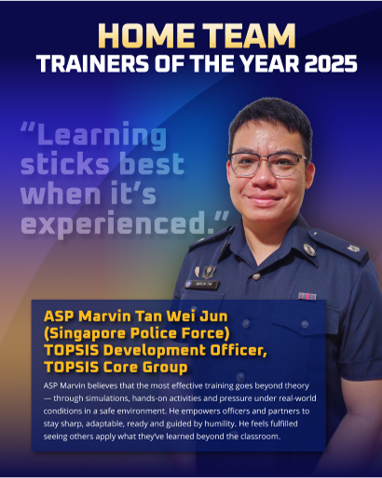
ASP Marvin Tan Wei Jun believes that the most powerful lessons are not delivered through slides alone, but forged through experience.
As a TOPSIS Development Officer at the Threat-Oriented Person Screening Integrated System (TOPSIS) Core Group, ASP Marvin plays a critical role in shaping how officers and partners in Singapore learn to detect and respond to potential security threats.
First implemented at Singapore’s border checkpoints in 2009, the TOPSIS programme equips officers with the ability to identify high-risk persons through behavioural cues known as Tell-Tale Indicators (TTIs), and subject them to enhanced screening.
As part of the TOPSIS Core Group, the subject matter experts for the programme, ASP Marvin supports ICA and border checkpoint stakeholders in reviewing and sustaining TOPSIS implementation. He also works with non-checkpoint agencies, such as religious organisations, that are interested in adopting the programme at their premises.
Learning That Sticks
One of ASP Marvin’s key innovations emerged from a simple question: how do you help learners truly appreciate the challenges faced by frontline operators?
For participants of the TOPSIS Specialist Course (TSC), understanding X-ray screening principles is essential. However, explaining them conceptually can only go so far. To bridge this gap, ASP Marvin developed a Timed Object Recognition Test designed to simulate the real-world pressures faced by X-ray operators.
During the activity, X-ray images flash on screen for only a few seconds. Participants must quickly detect anomalies and decide whether the image passes or fails. The time pressure is deliberate, placing learners under conditions that mirror operational reality.
The result is often a memorable moment in the course. More importantly, it reinforces a core belief ASP Marvin holds: learning sticks best when it is experienced.
“One memorable encounter is far more effective than many lectures,” he reflects. Simulation-based activities allow trainees to apply skills in a safe environment, where mistakes are treated as learning points rather than failures.
From Instruction to Engagement
ASP Marvin’s journey as a trainer did not begin with formal pedagogy. Early in his career, his experience came from conducting pre-shift briefings at Woodlands Checkpoint.
“I didn’t have formal training then,” he recalls. “I did what felt right, keeping lessons concise, covering the content, and trying to capture attention.”
That changed when he was seconded to the Centre for Protective Security. There, he was introduced to adult learning theories and training frameworks such as Bloom’s Taxonomy, VARK learning styles, and gamification.
These concepts reshaped how he designed and delivered training. ASP Marvin revamped TOPSIS courses such as the Advanced Tell-Tale Indicator Detection Course (ATDC) and TSC to cater to diverse learners.
In his experience, garnering interest first is key to knowledge retention. “When I attended courses as a trainee, I was most engaged when I could actively participate,” he says. “I wanted to bring that same level of engagement to my own lessons.”
When Training Multiplies Its Impact
For ASP Marvin, some of the most meaningful moments as a trainer come not from the classroom, but from seeing others take ownership of the programme.
He cites Heart of God Church as an example. Watching their core team members go on to train their own communities was, in his words, “humbling and deeply fulfilling.”
That impact became tangible during a red-teaming exercise conducted at Heart of God Church in May 2025. During the exercise, a role-player posing as a new visitor was quickly detected within minutes of entry. A Guest Experience volunteer engaged him, preventing the role-player from carrying out any planned surveillance tasks.
The volunteer shared that she was able to apply knowledge gained during TOPSIS training conducted by the church’s core team, quickly identifying TTIs such as loitering and unfamiliarity with the environment.
For ASP Marvin, this was validation. Training done well does not end with the trainer. Rather, it empowers others to carry the mantle forward, extending its impact beyond those directly taught.
Staying Relevant in an Uncertain World
In a volatile and complex security environment, ASP Marvin believes trainers must never assume they have “done enough.”
He keeps his curriculum current by staying informed on global security incidents and referencing materials such as the Singapore Threat Assessment Report. Case studies are regularly refreshed, and feedback is actively used to refine course design.
ASP Marvin’s message is straightforward: never assume you already know everything.
“What was right yesterday may need to be adapted to suit today’s context,” he says. Learning, in his view, is a continuous process that requires openness, reflection, and humility.
As a trainer, he sees his role as both a privilege and a responsibility. The lessons imparted form the backbone of decision-making on the ground. Done right, training does more than transfer skills.
“Always question your existing knowledge, continually look for ways to improve yourself, and learn from others in both formal and informal settings,” he advises. “Ultimately, recognise that we can always become a little better.”